Showing posts with label Description. Show all posts

Monday, March 2, 2020

Unreleased Draft from [8-15-16]: ABS12: Descriptions paragraphs

Fighter - Fighters can wear heavy protection armor for protection. A fighter uses various possible weapons to inflict damage. Their main role is to be able to absorb some physical damage while inflicting some damage. They protect and defend others.

Thief - Thieves wear lower middle protection armor for protection and rely on covert actions to hide and sneak. A thief uses sneak attacks to deliver heavier than normal damage using a dagger primarily.

Disciple - Disciples use no armor for protection and rely on covert actions or swift movement to avoid damage. A disciple uses thief fist, kicks, or throws to deliver heavier than normal hand-to-hand damage.

Hunter - Hunters use no armor for protection and rely on some covert actions and distance for protection. A hunter uses ranged attacks to deliver damage at a distance.

Musician - Musicians help inspire others and affect others through their powerful songs.

Druid -

Healer -

Magic User -

Elementalist -

[2/29/20 Note on this previously unreleased blog post:
This blog post had been sitting somewhere after 8-11-16 post titled ABS12: Ranged Weapons. Druid through Elementalist remains incomplete and undefined. It represent a "what could have been a fantasy profession or class category system for ABS12. A Basic System 12 latest online version was last update 8-25-16, which was right after creating a character example of steps 1 to 12.

For now, this character Descriptions paragraph be published "as is" separate from ABS12 system (maybe supplementary) will remain copyright Ken Wickham © 2020. All rights reserved. This content cannot be transmitted, stored, or rebroadcast without expressed consent of the author.

The main 2016 ABS12 system will remain without established character Descriptions.
]

Sunday, July 14, 2019

Summertime Writing: Substituion In Stories

In the last innovation post, I tried to use the association method for story innovation. In this post, I'd like to try the SCAMPER method of innovation and creativity. I will do the first of the seven parts of the SCAMPER method in this post—Substitution.

1. State the original idea, problem, or question (source).


For this case, Mary Shelley's Frankenstein Synopsis found at Wikipedia. I cut together pieces of the larger synopsis.

tells the story of Victor Frankenstein, a young scientist who creates a hideous, sapient creature in an unorthodox scientific experiment...the Creature tall, about 8 feet (2.4 m) in height and proportionally large. Despite Victor's selecting its features as beautiful, upon animation the creature is instead hideous, with watery white eyes and yellow skin that barely conceals the muscles and blood vessels underneath. Repulsed by his work, Victor flees when it awakens. While wandering the streets, he meets his childhood friend, Henry Clerval, and takes Henry back to his apartment, fearful of Henry's reaction if he sees the monster. However, the Creature has escaped.

Intelligent and articulate, the Creature relates his first days of life, living alone in the wilderness and finding that people were afraid of and hated him due to his appearance, which led him to fear and hide from them. While living in an abandoned structure connected to a cottage, he grew fond of the poor family living there, and discreetly collected firewood for them. Secretly living among the family for months, the Creature learned to speak by listening to them and he taught himself to read after discovering a lost satchel of books in the woods. When he saw his reflection in a pool, he realized his physical appearance was hideous, and it terrified him as it terrifies normal humans. Nevertheless, he approached the family in hopes of becoming their friend. Initially he was able to befriend the blind father figure of the family, but the rest of them were frightened and they all fled their home, resulting in the Creature leaving, disappointed. He traveled to Victor's family estate using details from Victor's journal, murdered William, and framed Justine.

The Creature demands that Victor create a female companion like himself. He argues that as a living being, he has a right to happiness. The Creature promises that he and his mate will vanish into the South American wilderness, never to reappear, if Victor grants his request. Should Victor refuse his request, The Creature also threatens to kill Victor's remaining friends and loved ones and not stop until he completely ruins him.
Fearing for his family, Victor reluctantly agrees. The Creature says he will watch over Victor's progress. 

2. SCAMPER

Substitute is about replacing parts of the story. Characters, description, setting, plots, or conflicts may be replaced with alternatives.
Combine
Adapt
Modify, minimize, or maximize
Put to another use
Eliminate or elaborate
Reverse

Substitute

  • Genre
A common type of replacement is genre. Maybe instead of horror, replace it with a modern setting. What if this happened in the stone age. Or maybe Frankenstein happened in ancient Egypt.

  • Characters
Characters may be replaced. Maybe Victor Frankenstein is a woman—much like the author Mary Shelley—Victoria Frankenstein. Or maybe he is an artist that brings to life a painting instead of a alchemy creature. A singer might bring to life a creature or being from a song.

  • Setting
Already I mentioned Egypt in the ancient genre which would be a different location. What about in China if a alchemist were trying to make a kung-fu soldier. Maybe on Easter Island, those faces were their attempt at a rock golem.

  • Plot
Maybe Dr. Frankenstein was trying to create his own bride instead of for the monster, more like the movie Weird Science. Maybe instead of the creature trying to kill him, the creature is constantly trying to save Dr. Frankenstein from foolish dangerous endeavors.

  • Description
Maybe instead of describing things in letters, as Mary Shelley does, the book is described using text messages. Or maybe I take the original text and change portions of the text. Let me try this now.

From Frankenstein Chapter 1 (after the letters)

I am by birth a Genevese, and my family is one of the most distinguished of that republic. My ancestors had been for many years counsellors and syndics, and my father had filled several public situations with honour and reputation. He was respected by all who knew him for his integrity and indefatigable attention to public business. He passed his younger days perpetually occupied by the affairs of his country; a variety of circumstances had prevented his marrying early, nor was it until the decline of life that he became a husband and the father of a family.
Paragraph below is based on the above paragraph
Paragraph 1, Chapter 1 Frankenstein, 
©2019 by Ken Wickham, all rights reserved. This is based on Mary Shelley's original text.

I was born into a family, who are famous, originating from the Geneva Republic. My ancestors had been longtime government officials and ambassadors, and my father had held several public offices with honorable and with a great reputation. Everyone that knew him respected him for his integrity and untiring attention to public service. He spent the good amount of time early in his career constantly focused on the needs of his country; many reasons prevented him from getting involved in dating in his youth. It wasn't until he was already near retirement that he married and became a father.

Analysis of Substitution

This exercise was easier for me than some of the last exercise. I even enjoyed rewriting the paragraph of Frankenstein using my own words and description. So far, I really like substitution as a tool for innovation in story writing.

Tuesday, October 16, 2018

Character Mechanisms - creating character profile instructions (part 4)

This is part of a series of posts to create a character using Character Mechanisms using the Character Profile sheet.

From the last post, I created a hierarchy of the character profile information. I'll focus on the group A first, which are the most important of the information for most occasions.

Priority A

Group A Important
Character Generator
Human Generator
Motivation Generator
Mood-Emotion Generator
Body Language Generator

So first I begin with the Character Generator.

1. Character Generator

Up to six categories are presented. They are 1) personality, 2) stat archetype, 3) encounter, 4) virtue, 5) vice, and 6) quirk.

You may use as many or all of these that you want. A) You may roll up an entirely random character. B) Or you may use them as lists and select the qualities that you like. C) Or roll up qualities and change the character in ways that make sense to you. D) One fun method may be rolling 6 times in a pool first, and then assign the results one at a time to each part of the character. E) In social settings, you may roll a pool of dice and have each participant assign a character aspect using up each die. F) A story writer might only want to roll only the necessary part(s) of the character at an appropriate time in the story and over time reveal the character’s true nature.

Although they are presented in an order, you may roll in any order.

Qualities in any order
  1. all in order
  2. list select
  3. roll & change
  4. pool & assign
  5. pool & group assign
  6. roll only necessary
For this example character, I don't have any preconceived character idea. I'll do an entirely random character rolling in order, method A.

For rolling, I just make a spreadsheet with a =RANDBETWEEN(1,10) function in 6 cells. Then I copy pasted the results here below.
1d10, 6 times
3106215
3, skeptic
10, charismatic
6, guard
2, temperance
1, lust
5, diagnosis
Let me copy past some of the information to help inspire this unnamed character. This information will be used in the future for reference purpose. Having it here will save me some time.

No Name Yet
Skeptic - They seek the truth. They are tempted to be elsewhere and self-sufficient, not asking for help. They fixated on vengeance and they objectify abstract concepts into concrete actions. They desire self-protection. They fear being controlled, harmed, or violated. Debate and lust are their common expressions. When not challenging others, they desire to be innocent.


Charismatic - has high charisma and presence. He/she is outgoing and expressive.


Guard - police, cop, deputy, security, sentinel, army, patrol, sentry, watchman, warder, warden, keeper, fighter

Temperance - temperance might represent self-control, restraint, or moderation. Or it might represent justice, humanity, or concern for others.

Lust - lust might be the self-absorbed desire for something. Lust might be wanting or needing something even something mysterious or unknown.

Diagnosis

Record these qualities in the section of the character profile sheet along with the name if known.

Character Generator random Qualities
Next I will do the Human Generator creation.


2. Human Generator
The Human Generator rolls up a description. I will do 6 traits for now based on the advice. I don't know what type of character this is, but half should suffice. I'll also try using method C mentioned in the last generator, pool & assign, picking which traits and which numbers I want to use. Because I am using method C, I will only need to roll once instead of twice.

The number of human characteristics rolled may be limited by the type of character.
Main characters most likely are detailed with all or most of these twelve characteristics fleshed out.
Major significant and important characters might have half or more of these details revealed.
Minor significant, but important characters to the story may have three to half of these characteristics known.
Background characters focused briefly on in a scene, however that aren’t important, may have one or two characteristics observed.

6 8 9 4 1 9
I don't know the gender of this character. I will not assign one at this time.

First, I will pick the body shape since this is a guard-type charismatic character. I want a fit looking character:  hourglass, or square shaped. I'll pick hourglass since that is fit.

Next I will do hair style & length. Long and straight sounds good.

Next assigning the hair color would go great with the hair style. Dark auburn sounds ok.

Next I'll do skin color. This character is from a cold area, so maybe porcelain.

Next I'll do eye color. Hazel sounds good.

Finally, I'll do chest size. Having a large chest sounds ok.

6 Hair Color: dark auburn
8 Chest or Breast size: large (DD/E cup)
9 Hair Style & Length: long straight
4 Body Shape: hourglass with narrow waist
1 Skin Color: porcelain
9 Eye Color: hazel

I don't know the other details such as height and facial feature shapes.  All of that can be added or decided later, if the character requires those details.

So far, this is how much this example character has created after two generators.
With Human Generator random traits added
I'll work on the next two in the next post.

Friday, July 8, 2016

ABS12 : 5 new descriptions: Hunter, musician, disciple, elemental, and druid

All the changes from this page will be added to the complete master game page at A Basic System 12 (ABS12).


[click to elnarge]

Herbalism - this is to both use and find herbs for healing, curing, and treatment of ailments for both humanoids and kindred creatures.


A Basic System 12 (ABS12)
Index of my blog

Saturday, June 4, 2016

ABS12: New species, description changes

I removed the speed that was counted double from fighters and thieves. Therefore fighters get 3 build points and thieves get 2 build points to buy verb actions.

I added some more species such as centaurs, scorpionfolk, lizardfolk, giant spider, etc.

In addition I attached the alterations to turn species into different types of that creature. Included is turning any species int a fighter, magic user, healer, and thief by stacking a few more points on top of the regular species stats. This is good for named or main boss type species. I plan on doing more in the future if it turns out okay.

Excuse the naming for alterations. I wasn't feeling creative: fightify, magicify, thiefify (whoops) even misspelled it), and healify. I'm just trying to make all alterations have an 'ify' suffix for now, to keep me from confusing it with the humanoid section.

[Click picture to enlarge]


ABS12: PL0 info added

All the changes from this page will be added to the complete master game page at A Basic System 12 (ABS12).

I added PL0 to the charts that I recently made.

Also I adjust this info near the bottom with the encounter information.

0 PL, 0DL represents an unlearned species. Only gives 1 to life, speed, and defense as well as the basic weapon, natural weapon, armor, and essential functional verbs not derived by training or development. Do not add any verbs derived from any kind of training. They do not receive such basic training until PL1.


Friday, June 3, 2016

ABS12: PL base statistics

All the changes from this page will be added to the complete master game page at A Basic System 12 (ABS12).

Instead of listing every creature by power level, I'd like to experiment having a base skill core for all creatures - which already is in the design - and create all the non-human's descriptions so that they can be created at any PL. Then I'll remove the PL encounter lists that I made per PL, leaving somewhat simple calculations.

I'll also need to make a conditions list such as zombify.

For now, I'll put the top one visual near the description list on top. And the numerical chart will go near the bottom near the entire the entire description list.


A Basic System 12 (ABS12)
Index of my blog

Wednesday, June 1, 2016

ABS12: Description update, Magic User

All the changes from this page will be added to the complete master game page at A Basic System 12 (ABS12).

I'm going to apply the data from the other days to the descriptions. I haven't adjusted the four descriptions in the encounter PL0, PL1, PL2 sections yet however, until next creature update. You can do it manually until then.

Biggest changes
Thief decreased covert to 2 and gains 1 life, Fighter decreases speed to 1, Magic User will get 3 build points in another spell or alchemy skill.

Humanoid Species Descriptions:
These are the basic four humanoid species descriptions in many fantasy worlds.

Humanoid species include humans, orcs, dwarves, elves, halflings, gnolls, goblins, hobgoblins, kobolds


Depending on the game world players may also play using one of the many non-humanoid species found at the back of the game as well. Use those stats for such occasions.

Magic User spells
Magic Users get 3 build points to get new spells besides fireball.

Magic Users Spells: disease, poison, splinter smash, firecone, corrupt touch, fear, drain touch, corrupt stare, petrification, charm, dig, fly, immune (to one element or poison/disease), aware, defense (increase defense temporarily), covert (invisible), or offensive bonus. Each build point raises damage up the scaling damage chart from 1 to a current max of 6 damage levels [(1d12*3) /4].


A Basic System 12 (ABS12)
Index of my blog

Monday, May 30, 2016

ABS12: The anatomy of the combat numbers

All the changes from this page will be added to the complete master game page at A Basic System 12 (ABS12).

For this post, I wanted to look into what exactly the numbers in the formula mean. This is important to help determine how to describe actions.

Minor change

One other change I'm making is removing the PL from PL damage roll, PL Live, and PL defense, which don't seem to make sense anymore.

Verb Skill formula portions


1. Situation roll portion
The first roll 1d12, in every type of roll means the situation roll. Situations can vary from good to bad. The first random roll tells you how good current situation about the skill or combat.

Player should describe exactly how the character does something, not just what a character does. 

If a character uses a description verb to look for clues, then the player should explain exactly how the player will search for clues. Will they look through all the drawers and cupboards? Having explained how the character will search, the roll can then be performed to describe how lucky fate is with the character in performing the task.

Interpreting the numbers
A 1 is so bad that it's a fumble. A 12 is so good that it's a automatic success.

Describing the situation depends upon what type of action is being performed. Once you have that action in mind, you can describe the situation surrounding the action using adverbs and adjectives in similar degree to the the result rolled. The situation may be environmental. It may include actions of opposing characters. It may include the conditions of the character performing the action.

Above six becomes more positive.
Below six becomes more negative.

Here is a general adjective scale denoting quality and degree for the situation surrounding the how the action is performed.


If as in the prior example, if the character is looking through all the drawers and cupboards looking for clues, and the player roll a three - what does that mean?. A three is very bad. What could a very bad situation mean or look like when searching through cupboards and drawers? It might mean that the character rushes through the search doing a poor job of searching. It might also mean that despite ones great skill, something happens to be covering the thing that the character is trying to find. The first explanation is a more method based or quality of performance rational. Whereas the second one is luck based or quality of the environment. Either way, they both explain and describe a the situation that is very bad.

2. Learned description level and power level experience portion
Both the PL and DL portions are fixed. 

The PL represents experience as the character acquires more real world experience. Characters recognize patterns and appropriate methods just by watching life around them. The learn little tricks to help live even doing unskilled and untrained actions easier. They have life knowledge.

The DL represents learned skill. It represents actual study, practice, exploration, teachings, and education. They receive education formally or on the job.

The next portion of the formula appears in combat. It is a special kind of roll called the damage roll.

Offensive roll 1d12 + PL + DL + Damage roll

3. Why is the damage roll added to the offensive roll?
The damage roll represents how viscous and potentially damaging the attack, blow, or strike is. The damage roll is potential damage, rather than actual damage.It represents how deadly the strike could be - how much force and accurate the blow may be. Even with a little lesser luck, a very powerful attack my still do damage if the attack is powerful. Too much of a bad situation will make even a powerful attack miss. Yet a great situation might help a weak attack still hit and do damage depending on the defender's situation.

The lowest damage possible is 1. Even variable damage weapon will at least do 1 point of damage

In damages where even a roll of 1 is made out of 1d12/6, = is all one or the other. There is no fumble or automatic success from the damage roll. Your only trying to find the amount, in this case 1 or 2. It's either one or the 

Damage roll is countered with the armor value portion of the defense. The defender offsets the damage roll with their fixed defense which is made up of skill (DL) and experience(PL) plus any armor.


Damage Table


Sunday, May 29, 2016

ABS12: Description Build points, Special Verb Actions

All the changes from this page will be added to the complete master game page at A Basic System 12 (ABS12).

So far, when I added creatures I tried to convert them over from several other open sources games, using an unofficial conversion system that I have in my head, using general rules that I created after analyzing the Open Gaming License (OGL) data several weeks ago for the black bear. I wrote up a comparison chart of common creatures from different systems months ago for Aioskoru world. Equiped with the list and the general rules that were extracted I converted the creatures using OGL data.

Last night I began to build a spreadsheet to help look at descriptions from a point based system. This may lead to some sort of description creation guidelines. I also included my first sets of creature data, removing the bonuses gained during PL increase.

That chart is shown at the bottom of this post.

DL vs Special Verbs
When I wrote the descriptions initially, it began with the concept that being one of the descriptions, such as a thief, would begin with a DL1 in thieving skills. I realized shortly after that it would be nice to have special skill verbs (abilities, stunts, and powers) built into the overall description. And so I added verbs such as covert stab and covert which can go above and ontop the DL1 bonus.

I realized that I've never added the rules for the special verbs yet. I think I need to more explicitly write in. I am adding the following text to the game.

I changed a few of the titles to special verb skill and DL.

Special Verb Skilled action

1d12 + PL + DL + Special Verb

Special Verb Combat action

Offensive roll 1d12 + PL + DL + Special Verb Damage


Special verbs are skills that go beyond the normal DL bonus. They can be thought of as special feats, special abilities, stunts, or special moves. Use the bonus for the special verb on top of the DL for added bonus. For combat, used the special verb damage instead of the standard melee damage for attacks using special verbs.

Skilled Actions
The definition itself is a group of skills defined by the gamemaster or in solo play the player for whatever appropriate for whatever world is being played. Anything that fits in this definition in a game will get a DL bonus. For example. Thieves can do thief skills not mentioned in the special verb skill sections. They may get the basic DL bonus when picking locks - if that is something all thieves do in your game world. Maybe they are good at bar fights. Maybe they have underground connections.


Possible Reduction: 2 covert for the thief
On top I put the 4 character descriptions. Unfortunately for the thief, they may lose one point of covert in order to balance out the descroptions.

[Click to enlarge]

I'm adding this chart to the bottom of the game for future use and comparison. It may change over time. New definitions will be added.


A Basic System 12 (ABS12)
Index of my blog

Friday, May 27, 2016

ABS12: Synonyms for writing using the ABS12 Solo Game Engine

All the changes from this page will be added to the complete master game page at A Basic System 12 (ABS12).

ABS12 Solo Game Engine and Fact Generator
ABS12: Basic Fact Generator
ABS12 Solo Game Engine: Additionals, Branching, & Conditionals
ABS12: Synonyms for writing using the ABS12 Solo Game Engine
Testing the ABS12 Solo Engine and Fact Generator
ABS12: Story Engine
ABS12: Drama Escalator

ABS: Solo Gaming Engine - flexible version It contains 1d6, 1d8, Fate, Fudge, 1d10, 1d12, 2d6, 3d6, 1d20, 4d6 JAGS, and 1d100 columns and modifiers.

After test playing and looking over the ABS12 Solo Game Engine yesterday, it came to me that maybe a list of synonyms for the main engine terms might be helpful. It might help explain the different results using different wording. When I write I try to show the decision points using actions and descriptions, rather than noticeable transitional sentences and conjunctions. But still these concepts are underlying those story actions and descriptions.

ABS12 Game Engine System Synonyms

maybe - perhaps, possibly, conceivably, it could be (that), it may be, it is possible (that), perchance, for all one knows, mayhap, there's a chance

if and only if - on (the) condition that, provided (that), presuming (that), supposing (that), assuming (that), expecting (that), as long as, given that, in the event that, believing (that), judging (that), speculating (that), thinking (that), surmising (that), guessing (that), imagining (that)

unless - except if, save, except on the condition that, except under the circumstance that

however - but, still, yet, though, although, even so, anyway, anyhow, nevertheless, nonetheless, despite that, that said, just the same, all the same, for all that, be that as it may, all the same, having said that, notwithstanding, still and all, regardless, in any case, at any rate, anyhoo

also - and, together with, along with, with, as well as, in addition to, besides, furthermore, plus, too, additionally, further, moreover, on top (of that), over and above that, what's more, to boot, equally, and all, likewise, by the same token

yes - surely, certainly, absolutely, indeed, okay, Ok, of course, naturally, affirmative, unquestionably, assuredly, definitely, obviously, beyond/without question, by all means, without doubt, indubitably, undeniably, irrefutably, indisputably, undeniably, evidently, plainly, clearly, unmistakably, for sure, positively, unequivocally, really do

no - absolutely not, (most) certainly not, of course not, under no circumstance, by no means, not at all, negative, never, not really, nope, uh-uh, nah, not on your life, no chance in hell, no way, no way Jose, nay, not for the moment, on no account, nevermore, not in a million years, when pigs fly, when hell freezes over, on the contrary, denied

Fact Generator © by Ken Wickham 2016. All rights reserved.

This blog may not be reproduced in any form, stored in any retrieval system, or transmitted in any form by any means—electronic, mechanical, photocopy, recording, or otherwise for any other person—without prior written permission of the publisher, except as provided by United States of America copyright law.

Wednesday, May 25, 2016

ABS12: Basic Fact Generator

All the changes from this page will be added to the complete master game page at A Basic System 12 (ABS12).

ABS12 Solo Game Engine and Fact Generator
ABS12: Basic Fact Generator
ABS12 Solo Game Engine: Additionals, Branching, & Conditionals
ABS12: Synonyms for writing using the ABS12 Solo Game Engine
Testing the ABS12 Solo Engine and Fact Generator
ABS12: Story Engine
ABS12: Random Objects & Participants
ABS12: Drama Escalator

ABS: Solo Gaming Engine - flexible version It contains 1d6, 1d8, Fate, Fudge, 1d10, 1d12, 2d6, 3d6, 1d20, 4d6 JAGS, and 1d100 columns and modifiers.

A flexible version of the Fact Generator is now available at rpgnow/drivethrurpg

http://www.rpgnow.com/product/191261/ABS12-Fact-Generator-Flexible-Dice-v-10

Available for dice 2d6, 1d12, 3d6, and 1d20

What you need to use this chart

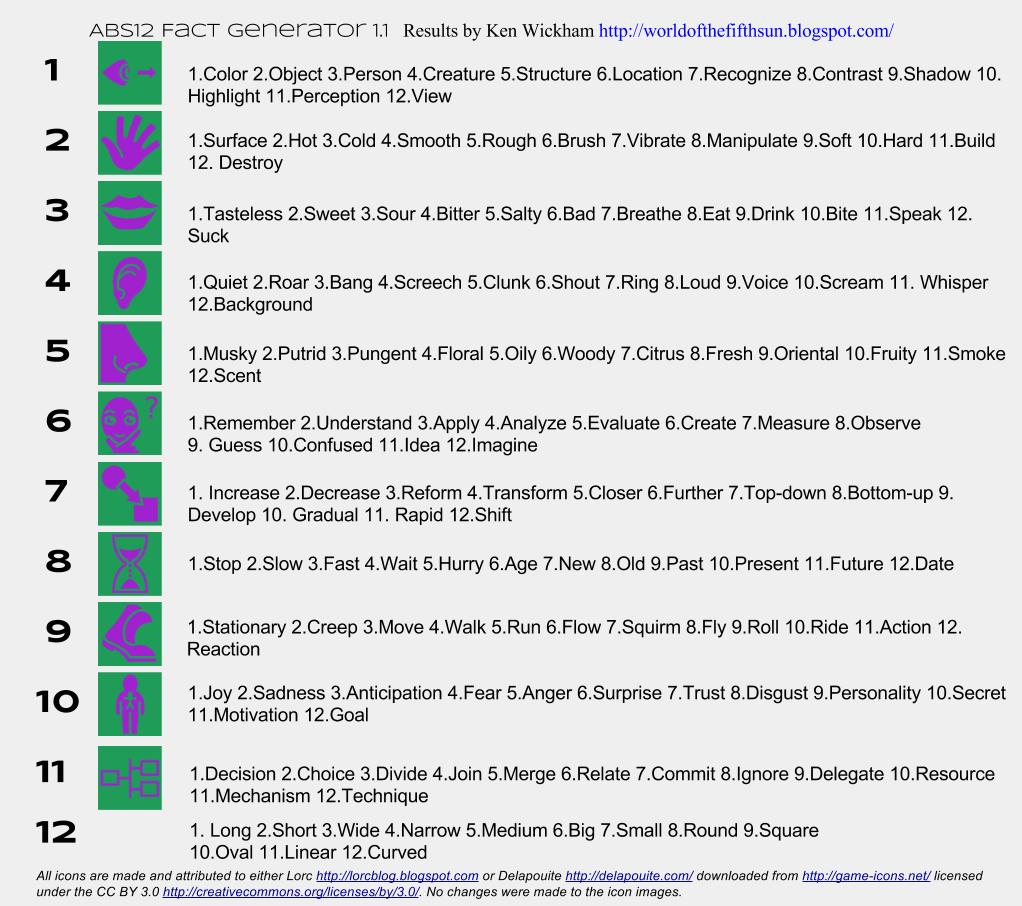
In addition to the Solo Game Engine, here is my attempt at a fact generator which can be used with one 12 sided dice.

A writer might use the lists to help with inspiration.

Directions

  1. First roll a 1d12 to find which row to consider: sensory, element of time and space, emotion/mood, or state of change. 
  2. Roll the 1d12 again to find a detail.
  3. Repeat as many times as needed.
  4. Discard or change as necessary.
  5. Interpret the result using creativity and considering your story situation.


For example. A roll of 1d12 resulting in 4 means something about sound, indicated by the ear symbol. Another roll of 1d12 equaling an 8 would indicate Loud.

Something in the story was loud. 

If you need further details you could roll more.

Lets say that you pile up loud, cold, and move. If in a modern house indicate something about a loud refrigerator vibrating. In space it might be indicate something about a scream from a cryogenic chamber. In a horror story or game it might indicate a chill running down a character's back pushing the character to flee as a loud rumble shakes the ground. In a fantasy story, it might indicate the launch of an ice ball from the trigger of a trap. 

It's just meant to help creativity. So use, discard, and change the results as needed.

[Click the chart to enlarge]


All icons are made and attributed to either Lorc http://lorcblog.blogspot.com or Delapouite http://delapouite.com/ downloaded from http://game-icons.net/ licensed under the CC BY 3.0 http://creativecommons.org/licenses/by/3.0/. No changes were made to the icon images.


A Basic System 12 (ABS12)
Index of my blog


Fact Generator © by Ken Wickham 2016. All rights reserved.

This blog may not be reproduced in any form, stored in any retrieval system, or transmitted in any form by any means—electronic, mechanical, photocopy, recording, or otherwise for any other person—without prior written permission of the publisher, except as provided by United States of America copyright law.